Is Metafuels Building a Real Alternative to Fossil Jet Fuel?
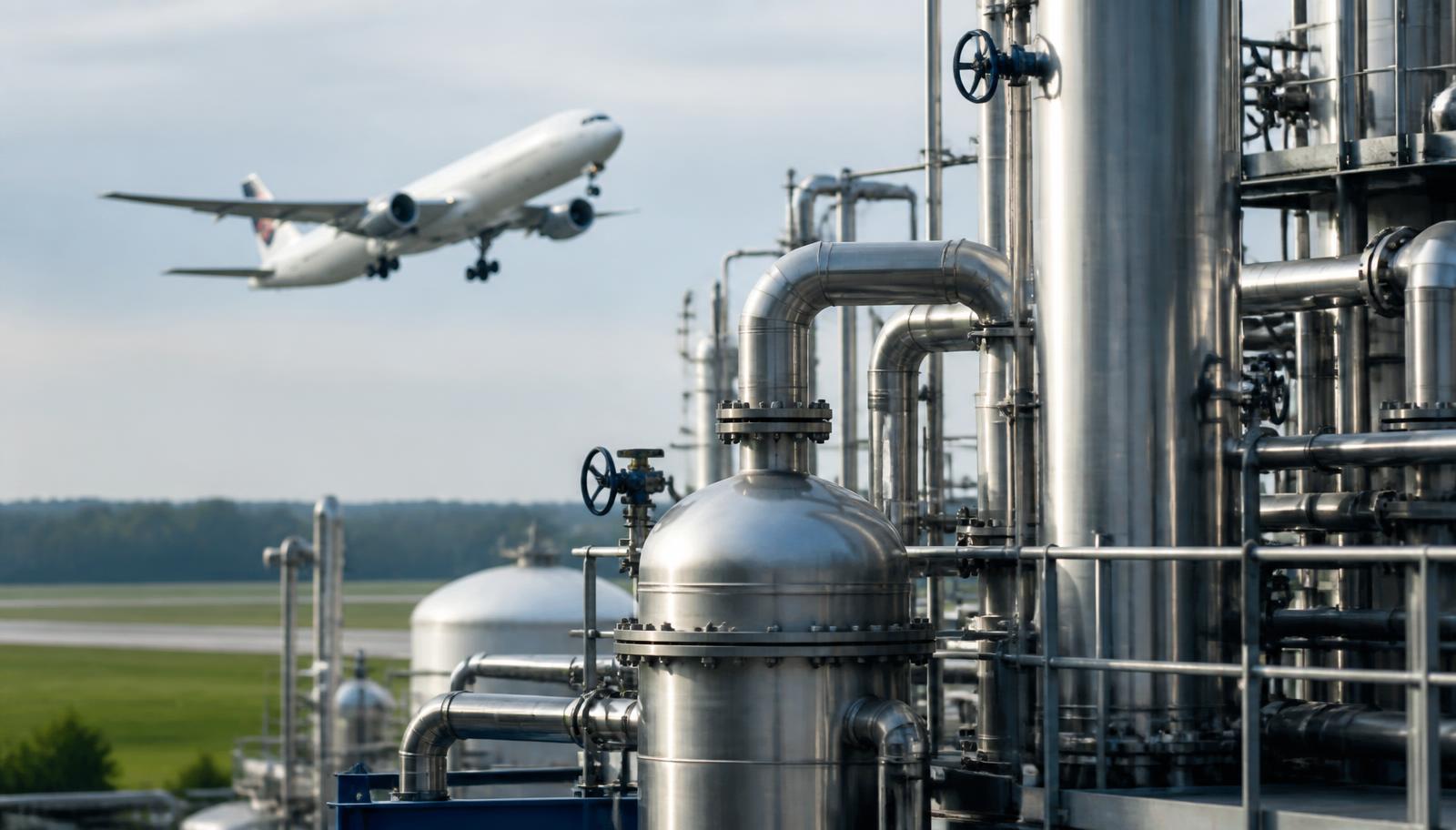
Metafuels is betting that the fastest route to cleaner flying runs through the fuel tank, not the aircraft.
Aviation has a particularly stubborn decarbonisation problem.
Cars can increasingly run on batteries. Electricity grids can replace fossil generation with renewables. But a long-haul aircraft needs an enormous amount of energy packed into something light enough to carry through the sky. Batteries remain too heavy for most commercial aviation, while hydrogen would require significant changes to aircraft and airport infrastructure.
Synthetic aviation fuel offers a different proposition: instead of redesigning the aircraft, redesign the fuel.
That is the bet behind aerobrew, a technology developed by Swiss company Metafuels together with the Paul Scherrer Institute (PSI).
On August 20, the partners inaugurated a new demonstration plant at PSI in Switzerland. Designed to produce around 50 litres of sustainable aviation fuel per day, the facility brings the full methanol-to-jet process together in what PSI describes as an industrially relevant plant design. The technology had already worked at smaller scales. The new plant is intended to show whether it can operate continuously under conditions that begin to resemble commercial production.
Less than two weeks later came another milestone. The wider Methanol-to-Jet pathway completed the ASTM qualification process required for new aviation fuels, creating a recognised route for fuels produced through the process to enter commercial aviation once they meet the relevant specifications.
Metafuels therefore has more than an interesting laboratory concept. It has an operating demonstration facility, a clearer path through fuel certification and plans for commercial plants.
But the claim behind aerobrew is much bigger.
Metafuels argues that its process can turn renewable methanol into synthetic jet fuel efficiently enough to make it a practical replacement for fossil kerosene. If that works, airlines could cut their dependence on fossil fuel without replacing aircraft, engines or the infrastructure already used to refuel them.
That is where the real Audit begins.
Aerobrew starts with methanol. Renewable methanol can be produced using hydrogen made with renewable electricity and carbon sourced from captured CO₂, as well as through some biomass-based routes. Metafuels then converts that methanol into the hydrocarbons needed for aviation fuel.
The important part of its innovation lies in how efficiently that conversion happens. Its proprietary catalytic process is designed to direct a high proportion of the feedstock toward molecules that can actually become jet fuel, rather than producing unwanted by-products.
That sounds like a technical detail, but economically it matters a great deal.
If more of the carbon and energy entering the plant ends up in useful fuel, less renewable methanol is needed for every litre produced. Better yields can mean lower energy demand, less wasted material and a cheaper finished product.
Metafuels says aerobrew achieves high carbon conversion and energy efficiency, and estimates that fuel produced through the process could reduce lifecycle greenhouse-gas emissions by as much as around 90 percent compared with fossil kerosene, depending on how the renewable methanol and other inputs are produced.
The new demonstration plant should provide much stronger evidence for whether those efficiencies survive outside smaller experimental systems.
But 50 litres per day is still 50 litres per day.
Commercial aviation consumes fuel on an entirely different scale.
Metafuels is already preparing for that jump. Its planned Turbe project in Rotterdam is intended to become the first commercial deployment of aerobrew. The initial facility is expected to produce around 10 tonnes of sustainable aviation fuel per day, with a later plant targeting roughly 100 tonnes per day. The company is also developing projects in Denmark and Spain.
Even the first Rotterdam plant would represent an enormous increase from the Swiss demonstrator.
It would still be tiny compared with the market it ultimately wants to serve.
Global airlines consume hundreds of millions of tonnes of jet fuel each year. IATA expects sustainable aviation fuel production to reach around 2.4 million tonnes in 2026, equivalent to less than one percent of total airline fuel consumption.
That puts Metafuels' scale challenge into perspective.
It is not simply a matter of building a bigger reactor. A large synthetic-fuel industry also needs an enormous supply chain behind it.
One advantage of methanol is that it is already a liquid commodity. It can be stored and transported relatively easily, which means Metafuels does not necessarily need to build fuel plants next to the cheapest renewable electricity. Renewable methanol can be produced elsewhere and transported to conversion plants located near ports, airports and existing fuel infrastructure. Rotterdam is attractive for exactly that reason.
But renewable methanol still has to be made.
For the e-fuel route, renewable electricity is used to produce green hydrogen. That hydrogen is combined with sustainably sourced carbon to make methanol. The methanol is then converted again into aviation fuel.
Every stage consumes energy.
This is where the apparent simplicity of synthetic jet fuel becomes more complicated. The finished product can behave much like conventional kerosene, but producing it requires substantial amounts of clean electricity before the aircraft even leaves the ground.
The Royal Society has identified this energy demand as one of the fundamental challenges facing synthetic aviation fuels. Its analysis of UK aviation found that replacing today's jet-fuel consumption with e-fuels could require several times the country's existing renewable electricity generation.
That does not mean synthetic fuel is an inefficient solution by definition. Aviation is one of the sectors where direct electrification is particularly difficult, which is why organisations including the International Energy Agency see e-fuels as potentially important for aviation and shipping.
It does mean those fuels will compete for renewable electricity and green hydrogen that other industries want too.
And that leads directly to the hardest part of the aerobrew proposition: price.
Sustainable aviation fuel is expensive. Synthetic aviation fuel is more expensive still.
EASA's 2025 reference prices put conventional aviation fuel at around €640 per tonne. Its estimated reference price for synthetic aviation fuel produced using industrial or biogenic CO₂ was around €7,520 per tonne, rising to €8,625 when atmospheric CO₂ was used.
Those figures are estimates rather than mature market prices because commercial synthetic-fuel production remains limited. But the size of the gap is difficult to ignore.
Aerobrew therefore does not merely need to make synthetic fuel somewhat more efficiently. If it is to become a genuine alternative to fossil kerosene rather than a premium product used mainly to satisfy regulation, several parts of the wider system need to become much cheaper at the same time.
Renewable electricity needs to become more affordable. Electrolysers need to improve. Green methanol production needs to expand. Sustainable sources of carbon need to be available at scale. And Metafuels' own process needs to maintain its promised efficiencies as plants become hundreds or thousands of times larger than the current demonstrator.
There are good reasons to expect some of those costs to fall. Analysis from the International Council on Clean Transportation suggests that e-kerosene production could become substantially cheaper as renewable power, hydrogen production and carbon-capture technologies mature.
But even optimistic projections still tend to leave synthetic aviation fuel considerably more expensive than fossil kerosene in the near term.
This is why aerobrew's efficiency matters without solving the whole problem.
A better methanol-to-jet process can make one part of the system cheaper. It cannot make renewable electricity free.
For airlines, that difference is particularly important. Fuel represents roughly a quarter of operating expenses, and the industry typically works with thin margins. IATA estimates that sustainable aviation fuel purchases will add billions of dollars to airline costs in 2026 despite accounting for less than one percent of total fuel consumption.
Metafuels is therefore entering a market that badly needs lower-carbon fuel but has limited appetite for paying several times more for it.
Regulation changes that calculation.
The European Union's ReFuelEU Aviation rules already require sustainable aviation fuel to account for a minimum share of fuel supplied at major EU airports. From 2030, the rules introduce a specific requirement for synthetic aviation fuels, with the mandated share increasing over time.
That creates something emerging technologies rarely receive: demand before cost competitiveness.
Airlines and fuel suppliers cannot simply wait for synthetic fuel to reach the price of fossil kerosene. Regulation is creating a market while the technology is still scaling.
Metafuels has aligned its commercial plans closely with that timetable. Its Rotterdam project is targeting production around 2030, when the EU's synthetic-fuel requirements begin to take effect. The company has also secured Dutch government support to advance engineering, permitting and commercial development for the project.
Airlines are beginning to engage too. SWISS announced a partnership with Metafuels in May aimed at supporting the development and scale-up of synthetic aviation fuel, while the airline and the wider Lufthansa Group are considering longer-term procurement arrangements.
That is not the same as proving a commercial market at scale.
It does suggest that adoption may be a smaller obstacle than production.
This is one of aerobrew's biggest advantages over more radical alternatives.
Hydrogen aircraft require new aircraft designs and new airport infrastructure. Battery-electric aviation would also demand major changes and is likely to remain constrained by range and weight for larger aircraft.
Synthetic kerosene is designed to fit into the aviation system that already exists.
Aircraft do not need to be replaced simply because the fuel changes. Airports do not need an entirely new energy-distribution network. Fuel certification removes another important barrier to use.
That compatibility could make synthetic fuel one of aviation's more practical routes to reducing emissions while the global aircraft fleet gradually evolves.
It does not make flying climate-neutral.
Aircraft burning synthetic kerosene still release CO₂ into the atmosphere. The climate case rests on where that carbon came from. If the carbon used to make the fuel was previously captured from the atmosphere or a sustainable biogenic source, then burning the fuel can form part of a carbon cycle rather than introducing fossil carbon that had been stored underground.
How clean that cycle becomes depends heavily on the inputs.
If hydrogen is produced using genuinely low-carbon electricity and the CO₂ comes from sustainable sources, lifecycle emissions can fall sharply. If the electricity comes from a carbon-intensive grid or the carbon source is poorly chosen, much of that benefit disappears.
Aviation also produces climate effects beyond CO₂, including contrails and nitrogen oxides. Synthetic fuel does not automatically eliminate those.
Aerobrew cannot make aviation environmentally consequence-free.
What it could do is reduce one of aviation's biggest problems: its dependence on fossil carbon, without requiring the industry to wait for an entirely new generation of aircraft.
The new demonstration plant strengthens that case. So does progress on fuel qualification. Metafuels has shown that the chemistry works, and it is now operating an integrated system designed to generate the data needed for commercial scale-up.
What it has not yet shown is that synthetic jet fuel can become affordable enough, or abundant enough, to compete meaningfully with fossil kerosene.
That is the constraint that now matters most.
The bottleneck is no longer simply inside the Metafuels plant. It sits across the energy system feeding it.
Aerobrew needs vast quantities of renewable methanol. That ultimately means vast quantities of cheap clean electricity, green hydrogen and sustainable carbon. Metafuels may be able to use those inputs more efficiently than competing processes, but it cannot escape their availability or their cost.
The real question, then, is no longer whether Metafuels can make synthetic jet fuel.
It can.
The question is whether the industrial and energy system around it can become large and cheap enough for that fuel to matter.
The Audit
- Evidence
- Aerobrew has progressed from laboratory and pilot work to an integrated demonstration facility, while the Methanol-to-Jet pathway has cleared an important fuel-qualification hurdle. That provides meaningful technical evidence. What remains unproven is sustained performance at commercial scale.
- Scale
- Metafuels has a credible expansion roadmap, including planned projects in Rotterdam, Denmark and Spain. But the gap between a 50-litre-per-day demonstrator and an aviation industry consuming hundreds of millions of tonnes of fuel is enormous. Scaling aerobrew also depends on scaling the renewable methanol supply behind it.
- Economics
- This remains the weakest part of the case. Metafuels' conversion efficiency could reduce costs, but synthetic aviation fuel is still many times more expensive than fossil kerosene. Cheaper renewable electricity, hydrogen and sustainable carbon are essential if that gap is to close.
- Adoption
- Aerobrew benefits from an unusually favourable adoption pathway. It is designed for existing aircraft and infrastructure, the Methanol-to-Jet pathway has advanced through fuel qualification, airlines are beginning to engage, and European regulation will create demand for synthetic aviation fuel from 2030.
- Impact
- If produced with genuinely low-carbon electricity and sustainable carbon, synthetic aviation fuel could substantially reduce aviation's lifecycle carbon emissions without waiting for the global aircraft fleet to be replaced. Its actual impact will depend on the cleanliness of its inputs and whether enough fuel can be produced to displace fossil kerosene at meaningful scale.
Audit Verdict
Metafuels has made a convincing case that renewable methanol can be turned into usable jet fuel. It has not yet shown that synthetic fuel can become an affordable alternative to fossil kerosene.
The demonstration plant reduces part of the technical uncertainty. Progress on qualification reduces part of the adoption uncertainty.
What remains is the much larger industrial challenge.
If clean electricity, green hydrogen and sustainable carbon become abundant and affordable alongside aerobrew, Metafuels could have a credible route to producing lower-carbon fuel for aircraft that are already flying today.
If they do not, aerobrew may work exactly as intended and still remain too expensive to transform aviation.
The chemistry is increasingly convincing. The economics of everything feeding it are not yet.
Sources
- Paul Scherrer Institute, Demonstration plant for sustainable aviation fuel inaugurated at PSI, 20 August 2026.
- Paul Scherrer Institute, A step closer to net-zero aviation: Methanol-to-Jet gets ASTM certification, 1 September 2026.
- Metafuels, aerobrew, 2026.
- Metafuels, $24M for climate-neutral flight: Metafuels brings synthetic aviation fuel to market at commercial scale, 18 February 2026.
- Metafuels, Metafuels secures €1.92 million Dutch government grant to advance Rotterdam e-SAF project, 1 April 2026.
- Port of Rotterdam, Metafuels and Evos partner to accelerate e-SAF production in Rotterdam, 16 May 2025.
- SWISS, SWISS teams up with Metafuels to further promote SAF, 13 May 2026.
- European Commission, ReFuelEU Aviation, 2026.
- European Union Aviation Safety Agency, 2025 Aviation Fuels Reference Prices for ReFuelEU Aviation, 26 February 2026.
- International Air Transport Association, Middle East Disruptions and High Fuel Prices Halve Airline Industry Profitability, 7 June 2026.
- International Energy Agency, The Role of E-fuels in Decarbonising Transport, 2023.
- International Council on Clean Transportation, Renewable Hydrogen and E-fuels Imports in the European Union, 2025.
- The Royal Society, Net Zero Aviation Fuels: Resource Requirements and Environmental Impacts, 2023.