Can Elon Musk Really Tunnel His Way Out of Traffic?
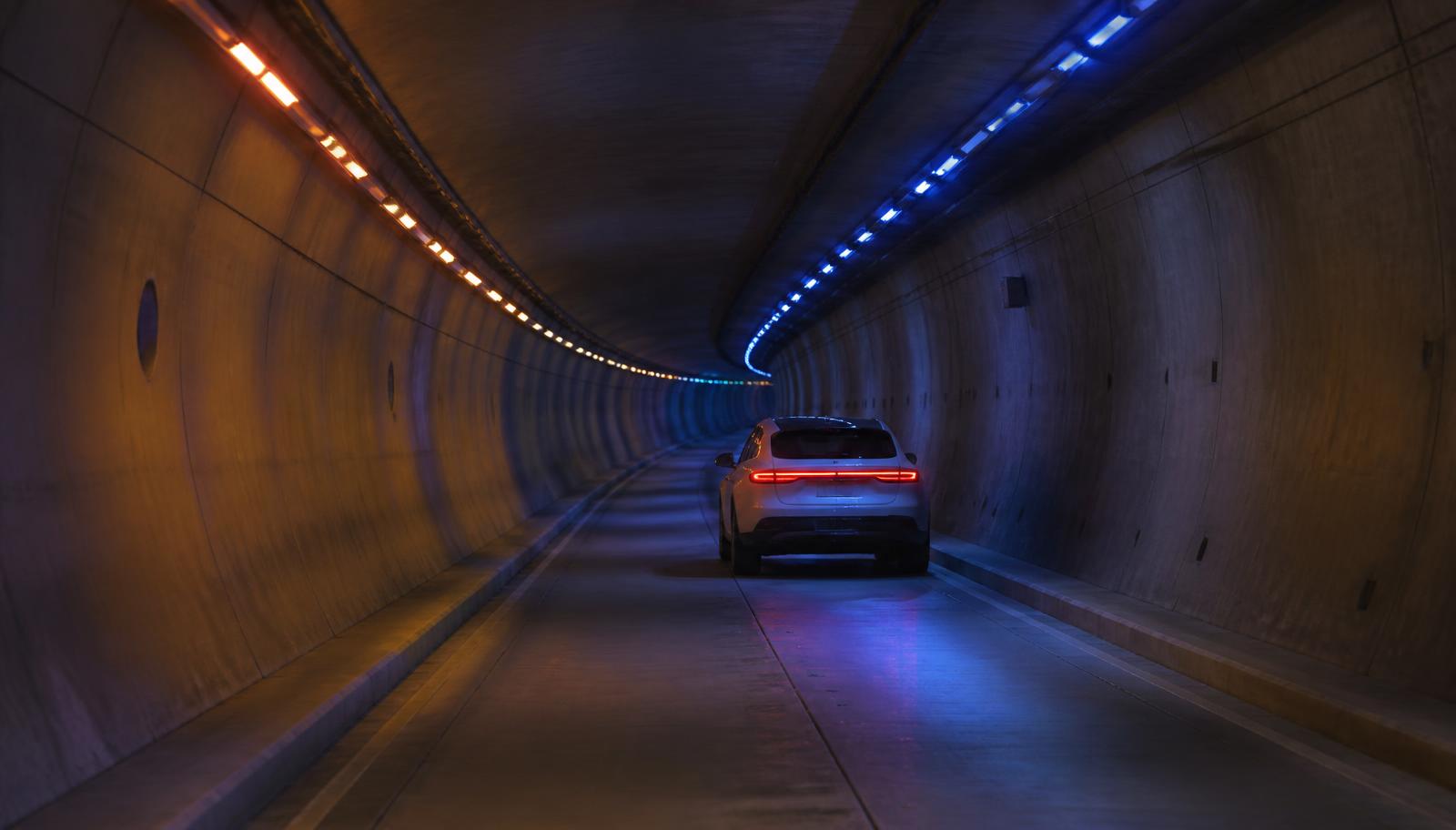
Beneath Las Vegas, the future of urban transport currently looks like a Tesla in a narrow tunnel. The Boring Company is betting $23 billion that cities will want much more of it.
Las Vegas is a fitting place to demonstrate a new form of transport. The city is built around spectacle, speed and the promise that ordinary rules can be suspended for a while. Beneath its convention centre and resorts, Tesla vehicles now carry passengers through a growing network of narrow tunnels, taking them directly to their destination without stopping at every station along the way.
It works. That matters.
The Boring Company says the Vegas Loop has already transported more than four million passengers through 14 stations, with journeys lasting between two and eight minutes. During its busiest periods, the company says the network has moved more than 6,500 passengers an hour and 35,000 in a day. These are not projections from a pitch deck but evidence that a tunnel-based service using ordinary electric cars can move large numbers of people through a contained urban area.
Investors are now betting that this evidence can travel. In September 2026, The Boring Company raised $3 billion at a valuation of $23 billion, roughly four times its valuation in 2022. The funding will support projects in Las Vegas, Nashville and Dubai, alongside plans for more than 150 kilometres of underground infrastructure across the United Arab Emirates.
The proposition is as characteristically Muskian as it is easy to understand: traffic exists because cities have run out of space on the surface, while the ground beneath them remains largely unused. If tunnels can be constructed quickly and cheaply enough, roads can expand vertically rather than horizontally. Instead of forcing every passenger onto the same train and through the same sequence of stops, small vehicles can provide direct journeys across a dense underground network.
The question is no longer whether The Boring Company can dig a tunnel or operate a shuttle. It can. The real question is whether putting cars underground changes the economics and capacity of urban transport enough to solve congestion at city scale.
For that claim to hold, several things would need to become true at the same time. The company would need to demonstrate that its tunnelling technology is consistently faster and cheaper across different cities and geological conditions. Its networks would need to carry enough passengers during peak periods without creating queues at stations or bottlenecks inside the tunnels. The system would need to operate economically once the costs of vehicles, staff, maintenance, ventilation, emergency infrastructure and expansion are included. Cities and private landowners would need to approve dozens or even hundreds of access points. Most importantly, additional underground road capacity would need to reduce congestion rather than simply encourage more car journeys.
The evidence starts in The Boring Company's favour. The original Las Vegas Convention Center Loop was built for approximately $47 million under a fixed-price contract, according to the company, while the Las Vegas Convention and Visitors Authority reported a total project cost of $52.5 million. It opened in 2021 after roughly a year of construction and transformed a walk of around 20 minutes across the convention campus into a journey of less than two minutes. The service has since expanded beyond the convention centre to nearby resorts.
This is a genuine infrastructure achievement. Large underground transport projects in the United States routinely become expensive, slow and politically difficult. The Boring Company has reduced complexity by using smaller, standardised tunnels, compact stations and commercially available vehicles. Its Prufrock tunnelling machine is designed to launch directly from the surface, install the tunnel lining continuously and operate without workers at the cutting face during normal excavation. The company is targeting tunnelling speeds above one mile per week and an all-in tunnel cost below $8 million per mile.
Those last figures, however, remain targets. They should not be confused with independently demonstrated performance across a completed city network. The cost of boring a standard tunnel is also not the cost of delivering an entire transport system. Stations, land access, passenger facilities, vehicles, control systems, ventilation, emergency exits and ongoing operations still matter. The simplicity that makes Loop cheaper is real, but so is the fact that it delivers a different kind of service from a metro.
That difference becomes clearest when capacity enters the picture.
A train concentrates hundreds or sometimes more than a thousand passengers into one vehicle. Loop distributes passengers across a large fleet of cars, generally carrying one party at a time. The company argues that this is an advantage: passengers leave immediately, avoid intermediate stops and can use much smaller stations situated close to their actual destinations. Capacity, in its model, comes not from making each vehicle larger but from adding more tunnels, stations and vehicles.
The approach appears effective within the convention-centre environment, where journeys are short, destinations are limited and demand can be managed around scheduled events. Yet citywide transport is less forgiving. Commuters arrive unevenly. Stadiums release tens of thousands of people at once. Airports generate luggage, accessibility requirements and unpredictable dwell times. Vehicles must merge, separate and circulate through a network without allowing a delay at one small station to spread elsewhere.
The Vegas Loop is approved to grow to 68 miles and 123 stations. The Boring Company says the completed network could serve as many as 90,000 passengers per hour. That number sounds comparable with a major urban transport system, but it is a network-wide target distributed across more than a hundred stations, not a demonstrated capacity through one heavily used corridor. The existing peak of more than 6,500 passengers per hour is meaningful evidence of operation. It is still a long way from proving the projected final system.
More tunnels can theoretically add capacity almost without limit, but doing so changes the nature of the claim. If the system needs a dense web of parallel tunnels and privately funded stations to match the throughput of high-capacity transit, cheap tunnelling becomes essential rather than merely desirable. The engineering advantage must be large enough to compensate for the inefficiency of moving relatively few people in each vehicle.
Automation will matter for the same reason. The service still uses human drivers, although the company says Tesla's Full Self-Driving technology has been demonstrated on selected sections. A paid driver in every small vehicle places a natural floor under operating costs. Removing the driver could materially improve the economics, but it would introduce another condition that has not yet been established across the working network. The Boring Company is therefore asking two technologies to mature together: rapid tunnelling and reliable autonomous driving in confined public infrastructure.
The financing model is more innovative than it first appears. The broader Vegas expansion is designed around private investment, with resorts and other property owners able to fund stations that connect directly to the network. Nashville's planned Music City Loop is also presented as privately financed, with passengers paying fares and no taxpayer funding used for construction or operation. For cities accustomed to waiting years for public budgets and major transport approvals, that is a powerful proposition.
Private funding, however, does not settle the economic question. The recent $3 billion round shows that investors believe the company may become valuable. It does not show that a completed Loop network can generate sufficient fare and station revenue to cover its full construction and operating costs. Public information about the system's revenue, cost per passenger and long-term maintenance requirements remains limited. Capital can finance the period in which a network is being built, but eventually the service itself must make the numbers work.
Adoption presents a similarly mixed picture. Las Vegas visitors appear to value the speed and convenience, while local authorities have approved a dramatic expansion. Nashville and Dubai give the company an opportunity to prove that the model works beyond a tourist corridor in Nevada. At the same time, earlier proposals in places including Los Angeles and the Washington region were abandoned or disappeared after encountering environmental, regulatory or practical barriers. Tunnelling beneath an existing city is not only an engineering problem. It requires permits, land agreements, emergency planning and public confidence at every stage.
Recent scrutiny in Nevada shows why that cannot be treated as background noise. State lawmakers have questioned workplace safety and environmental compliance around construction, while the company has faced complaints and penalties connected with its Las Vegas operations. Some disputed citations were later withdrawn after reviews found deficiencies in the cases, but other enforcement matters have continued. A company seeking permission to build extensive infrastructure beneath cities must demonstrate not only that its machines can move quickly, but that oversight, safety and environmental controls can keep pace.
Even if every operational issue is solved, the largest question remains: would a successful Loop actually reduce traffic?
The service removes vehicles from the surface for part of their journey, but its basic unit is still a car. Decades of transport research have shown that adding road capacity can attract additional journeys as driving becomes easier, weakening the original reduction in congestion. An underground network may shift where vehicles move and remove pressure from selected streets. That does not guarantee fewer car journeys across the wider city.
Loop could still have substantial value without replacing mass transit or eliminating congestion altogether. It may be particularly useful for connecting airports, convention centres, entertainment districts and other clusters where passengers value direct journeys and where compact stations can be funded by destination owners. It could complement trains and buses by serving routes that are too dispersed for a conventional line. That is a more limited claim than tunnelling a city out of traffic, but it may also be a more credible business.
This is where The Boring Company's strongest innovation and its biggest promise begin to separate. The company has made a persuasive case that tunnels can be smaller, more standardised and faster to deploy. It has also shown that passengers will use cars inside them. It has not yet shown that this combination can deliver the throughput, economics and network effects required to relieve congestion across a city.
The $23 billion valuation assumes that Las Vegas is the beginning of a repeatable infrastructure platform. Nashville and Dubai will examine that assumption more rigorously than another extension in Nevada can. If the company can reproduce its construction economics in different ground conditions, automate the fleet, manage peak demand and make a privately financed network profitable, Loop could establish a useful new category between ride-hailing and rail. If it cannot, the tunnels may remain an impressive way to move visitors between selected destinations rather than a solution to urban traffic.
The critical constraint is not tunnelling alone. It is passenger density: whether a network built around small vehicles can move enough people, cheaply enough, to justify constructing an entire underground road system around them.
The Audit
- Evidence
- The system works and has carried more than four million passengers. The strongest evidence comes from short journeys in a highly controlled Las Vegas environment, while several important performance figures remain company-reported.
- Scale
- Fourteen operational stations are meaningful progress, but they do not yet validate a planned network of 123 stations or a target of 90,000 passengers per hour. Nashville and Dubai will provide much stronger examinations of repeatability.
- Economics
- Smaller tunnels, compact stations and private financing could lower the barrier to new transport infrastructure. Full network economics, operating costs and the effect of continued reliance on human drivers remain unclear.
- Adoption
- Passengers are using the service, property owners see value in direct connections and several governments have approved expansion. Regulatory scrutiny and abandoned earlier proposals show that adoption cannot be separated from local governance and public trust.
- Impact
- Loop clearly improves selected journeys. There is not yet enough evidence that it reduces congestion across a wider city, particularly when its underlying model adds road capacity rather than moving large numbers of people in shared vehicles.
Audit Verdict
Las Vegas proves that Loop can move people. It does not yet prove that Loop can move enough people to change how a city moves.
The Boring Company has demonstrated something more substantial than a novelty: it can construct compact tunnels and operate a fast, appealing transport service inside them. What it has not demonstrated is the part that matters most to its larger mission.
For now, Musk has a credible tunnelling company, an operational transport network and a rapidly rising valuation. The claim that cities can tunnel their way out of traffic remains underground.
Sources
- Reuters, Musk's Tunnel Startup The Boring Company Raises $3 Billion at $23 Billion Valuation, September 10, 2026.
- The Boring Company, Vegas Loop, accessed September 2026.
- The Boring Company, Loop, accessed September 2026.
- The Boring Company, Prufrock, accessed September 2026.
- The Boring Company, Music City Loop, updated June 2026.
- Las Vegas Convention and Visitors Authority, $1 Billion Las Vegas Convention Center Expansion Debuts with First Major Convention Post-Pandemic, June 8, 2021.
- Associated Press, Musk's Underground Tunnels in Las Vegas Face Scrutiny Over Safety and Environmental Concerns, February 6, 2026.
- Nevada Division of Industrial Relations, Statement on Federal OSHA's Independent Review of The Boring Company Inspection, February 12, 2026.
- The Washington Post, The Boring Company Cancels Plans to Open One of Its Los Angeles Test Tunnels, November 28, 2018.
- UK Department for Transport, Induced Travel Demand: An Evidence Review, 2018.