If AI Can Run the Lab, Will Science Actually Move Faster?
Anthropic has shown that AI can increasingly operate the machinery of scientific experiments. The bigger question is whether faster experiments actually translate into faster scientific progress.
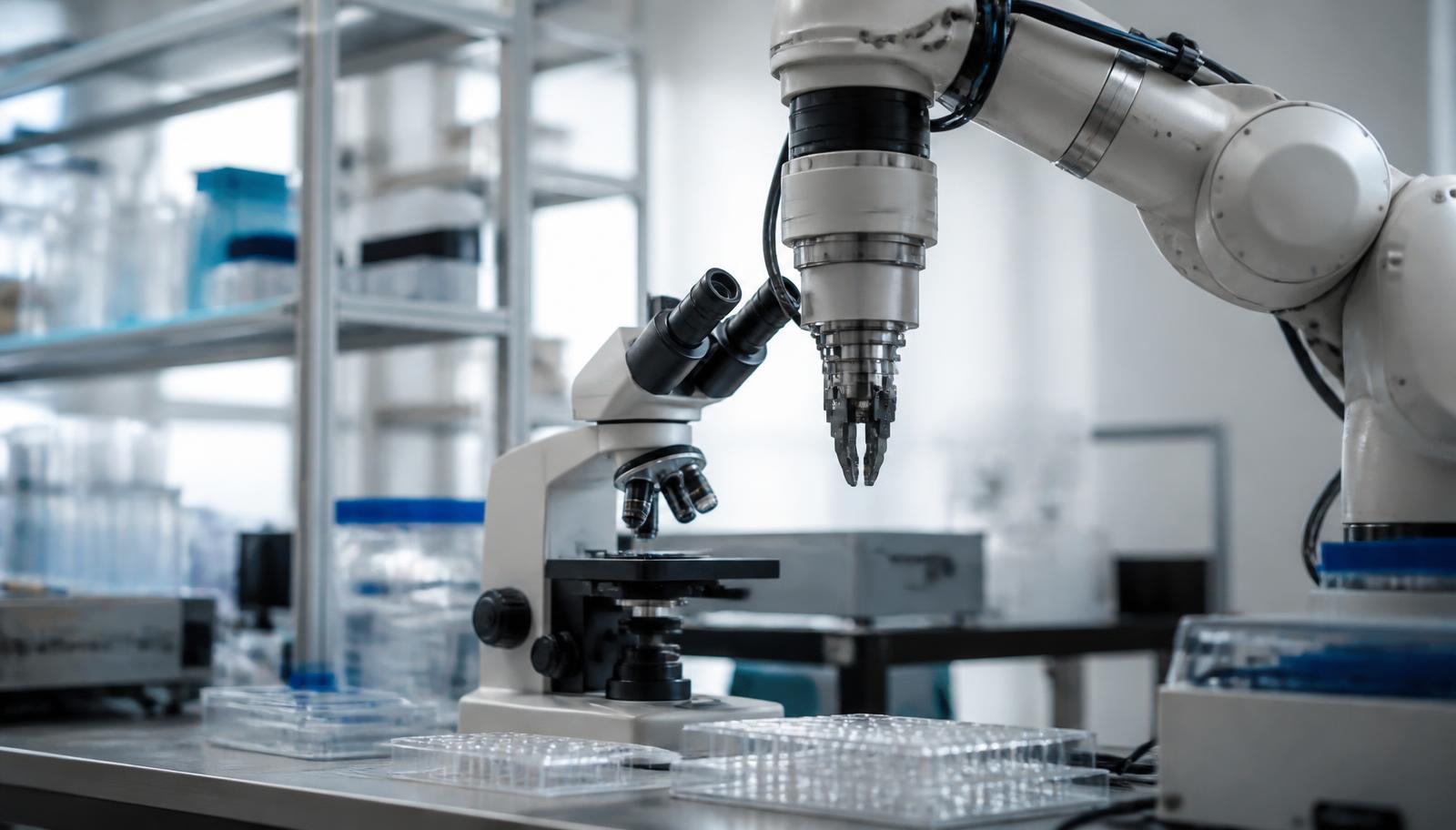
On 27 August, Anthropic introduced the Model Hardware Standard, or MHS, a new framework designed to let AI agents operate physical equipment used in laboratories and advanced manufacturing. In practical terms, MHS gives an AI system a common way to communicate with different machines, including microscopes, liquid handlers and robotic arms that would otherwise rely on separate software and custom integrations. Anthropic says work that can take laboratories weeks or months to set up can, in some cases, be reduced to hours or minutes.
That sounds technical, but the problem MHS is trying to solve is straightforward. A modern laboratory can contain equipment from several manufacturers. One machine moves liquids. Another measures samples. Another handles plates. Another captures images. Each may have its own interface, data format and operating instructions, leaving researchers or engineers to build custom connections before the machines can work together.
MHS is an attempt to give those machines something closer to a common language.
Once equipment is connected, an AI agent can receive information from the instruments, sequence actions between them, monitor results and adjust parameters as conditions change. Anthropic's longer-term vision is that this could make more experiments capable of running autonomously and around the clock.
And this is where the claim becomes much bigger than a new hardware interface.
If AI can take over more of the physical work involved in experimentation, laboratories could potentially perform more experiments, iterate faster and reduce the time researchers spend programming, monitoring and manually operating equipment.
The implied promise is compelling: automate more of experimentation, and scientific discovery itself could accelerate.
But for that to become true, several other things also have to hold up.
The first part already has meaningful evidence behind it.
Researchers at Carnegie Mellon University used MHS to coordinate a liquid handler, plate reader, robotic arm and monitoring cameras across three computers with incompatible interfaces. They reported completing serial dilution experiments roughly three times faster than before. More strikingly, the team says it built the necessary device drivers and orchestration layer in about eight hours, compared with the several weeks a vendor-built setup could typically require.
At Genentech, researchers used MHS in a proof of concept for automating a protein assay. Claude coordinated a liquid handler, robotic arm and plate reader, ran trial transfers, analysed the resulting measurements and adjusted flow rates to improve the accuracy of the procedure.
At the University of Washington's Baker and Pinglay labs, MHS has been used to remotely monitor instruments, supervise a qPCR process and coordinate a robotic arm with a liquid handler. The researcher involved describes an environment in which testing a new protein design at the bench can take around a week and cost roughly $100 per candidate, making experimental throughput a genuine constraint even when computational design has become extremely cheap.
So the underlying capability is not hypothetical.
AI systems can increasingly participate in the execution and monitoring of physical experiments.
But Anthropic is entering a field that already existed before MHS. Researchers have spent years developing what are commonly called self-driving laboratories, systems that combine robotics, automated equipment and algorithms capable of selecting, executing and interpreting experiments with varying levels of human involvement. A recent review in Nature Reviews Chemistry describes how these systems have evolved from relatively narrow automation tools towards more general discovery platforms.
That context makes MHS more interesting rather than less.
Anthropic has not invented the idea of an autonomous laboratory. Its potentially important contribution is addressing one of the stubborn practical barriers preventing autonomous experimentation from becoming more widespread: laboratory equipment is difficult to connect.
That problem is easy to underestimate.
Research laboratories are not factories. A factory may repeat the same carefully engineered process thousands of times. Scientific laboratories frequently change what they are doing. New experiments require different protocols, instruments and configurations. Equipment from different manufacturers may use completely different software and data structures.
A University of Washington researcher involved in Anthropic's preview estimated that integrating laboratory equipment can take months or years and cost anywhere from thousands to millions of dollars. That makes sophisticated laboratory automation inaccessible to many academic researchers.
If a shared standard genuinely makes those connections dramatically easier, MHS could lower an important barrier to automation.
But that only gets the claim through the first part of the audit.
Working in a handful of carefully selected laboratories is different from becoming infrastructure that works across science.
MHS is still a research preview offered to a limited group of partners. Anthropic has not yet open-sourced the standard and says it is using this phase to expand hardware support, develop safety evaluations and understand how the system behaves in more physical environments. It also acknowledges that MHS cannot currently operate equipment without a programmable interface.
The wider field faces the same problem. The 2026 Nature Reviews Chemistry assessment identifies scalability, generalisability and complete records of experimental activity as three major requirements if self-driving laboratories are to develop from isolated systems into shared scientific infrastructure.
Science is unusually difficult to standardise.
A chemistry laboratory, a neuroscience laboratory and a semiconductor research facility may share almost no equipment. Even laboratories studying similar problems can use different instruments, protocols and materials. Biological experiments introduce living systems that can behave unpredictably. Other experiments require physical manipulation that remains difficult to automate.
And when something unexpected happens, operating the machine correctly can require more than following written instructions.
Genentech's early experiments offer a useful example. Claude initially used generic liquid-handling parameters for both ordinary water and a more viscous protein solution. The protein sample formed bubbles, disrupting the transfers and triggering errors. When Claude encountered problems caused by the bubbles, its first instinct was to retry the operation with different parameters. That made the problem worse because the system had not understood the physical reason the experiment was failing. Human researchers had to explain what was happening before it could respond appropriately.
It is a small example that reveals a much larger constraint.
Laboratories exist in the physical world.
Liquids foam. Samples degrade. Instruments drift out of calibration. Materials behave differently at different temperatures. Sensors fail. Biological systems surprise researchers. Experienced scientists often recognise that something has gone wrong because of context, intuition and knowledge of how physical systems behave.
Anthropic itself acknowledges that current models still have limitations in spatial and physical reasoning and require expert oversight.
That matters because the consequences of an AI mistake change when the model moves from generating text to operating physical machinery.
An incorrect answer from a chatbot is one thing. An autonomous system controlling robotic equipment, chemical materials or biological experiments introduces a different category of risk. Research into self-driving laboratories already argues that safety will need to be designed into increasingly autonomous systems as their capabilities and experimental scope expand.
That turns adoption into more than a question of whether researchers find the technology useful.
Laboratories will need to determine which actions an AI agent can take autonomously, which require human approval, how failures are handled, who carries responsibility when something goes wrong and how every decision made during an experiment is recorded.
That final point may become particularly important.
Scientific knowledge depends on more than obtaining a result. Another researcher must be able to understand how that result was produced. As autonomous laboratories become more complicated, the scientific record needs to capture not just the final measurement but the decisions, parameters, adjustments and equipment states that produced it.
The latest research on self-driving laboratories therefore places considerable emphasis on provenance-complete experimentation, essentially ensuring that the entire experimental process remains traceable even when machines are performing more of it.
In other words, making science more autonomous also creates a need to make autonomous science more auditable.
The economic case for MHS may ultimately prove stronger.
Highly automated laboratories can be expensive because every new piece of equipment may require specialist integration. Anthropic's early results suggest that AI-assisted standardisation could substantially reduce some of that work. Carnegie Mellon's eight-hour integration example is particularly striking, while the University of Washington demonstrations suggest researchers may also save considerable time currently spent manually monitoring and moving between machines.
But the complete economics remain unknown.
Laboratories may still need automation-compatible instruments, robotic equipment, sensors, computing infrastructure, technical expertise and safety systems. Running AI agents for long experimental periods also creates compute costs, something Anthropic's own research partners note will have to be weighed against the researcher time saved.
So there is a credible economic argument here, but not yet a proven one.
And even if MHS ultimately makes autonomous experimentation dramatically cheaper, one larger question remains.
Imagine a laboratory currently completes 100 experiments per month.
Automation allows it to complete 1,000.
It is tempting to describe that as a tenfold acceleration in science.
But experiments are not the same thing as scientific progress.
Those 1,000 experiments still need to be asking useful questions. Their measurements must be reliable. Unexpected findings need to be interpreted. Promising results need to be checked. Experiments may need to be repeated, challenged and reproduced elsewhere.
Science is not simply a system for producing experimental results.
It is a system for turning evidence into reliable knowledge.
There is good reason to believe autonomous laboratories can accelerate parts of that process. A 2026 review of benchmarking research found that self-driving laboratories can substantially accelerate the search for top-performing results in certain materials-science problems, with reported acceleration varying considerably depending on the experimental space. But the same review also found that direct benchmarking is far from universal. Only about 40 percent of the self-driving-lab studies the authors examined had directly attempted to benchmark performance.
That distinction matters.
The strongest cases for autonomous experimentation currently tend to involve problems that are relatively well defined: search a large space of possible materials, formulations or parameters and use each experimental result to determine what should be tried next.
In those environments, running experiments faster and choosing them more intelligently can clearly accelerate learning.
But scientific discovery is not always a neatly defined optimisation problem.
Sometimes progress comes from realising the original question was wrong. Sometimes an unexpected observation matters more than the measurement researchers intended to make. Sometimes the difficult part is not generating more data but determining which evidence deserves attention.
And sometimes the slowest part of innovation exists entirely outside the laboratory, in clinical trials, regulation, manufacturing or the years required to establish that a finding is genuinely useful.
This is where the central constraint behind the MHS story becomes visible.
AI may remove one scientific bottleneck without removing the others.
If laboratories can generate experimental evidence dramatically faster, the constraint may simply move from performing experiments to interpreting, verifying and making sense of them.
Anthropic's own partners appear to recognise this division. Genentech describes a future in which AI handles more of the repetitive mechanics of experiment execution while scientists remain focused on experimental design, interpretation, decision-making and invention.
That may ultimately be a more realistic and more consequential vision than the idea of an AI scientist independently making discoveries.
MHS does not need to replace scientists to matter.
If it allows researchers to spend less time programming equipment, monitoring instruments and repeating routine processes, while making sophisticated automation accessible to laboratories that could not previously afford it, that alone could meaningfully change how experimental science is conducted.
But the larger promise still has another hurdle to clear.
Anthropic is beginning to show that AI can make the laboratory move faster.
Whether scientific progress moves faster with it is the part we have not yet established.
The Audit
- Evidence
- The underlying capability is clearly more than a concept. Anthropic's partners have demonstrated AI agents coordinating real laboratory equipment, monitoring experiments, adjusting parameters and autonomously completing parts of experimental workflows. Carnegie Mellon reported roughly threefold faster execution in one use case. But much of the evidence for MHS specifically still comes from selected proof-of-concept deployments published by Anthropic and its partners rather than broad independent evaluation.
- Scale
- MHS addresses a genuine scaling problem by creating a shared interface between otherwise incompatible equipment. But it remains a research preview, many instruments still lack suitable programmable interfaces, and performance across large numbers of laboratories, scientific disciplines and more complex experimental environments remains unproven. The wider self-driving-lab field continues to identify scalability and generalisability as major unresolved challenges.
- Economics
- Early examples suggest MHS could dramatically reduce the time and specialist work required to integrate equipment, potentially lowering one of the major costs of laboratory automation. The complete economic case is still uncertain. Hardware, robotics, maintenance, compute, specialist oversight and safety infrastructure remain relevant, and there is not yet enough evidence to establish the cost-benefit equation across laboratories at scale.
- Adoption
- There is a clear incentive to automate repetitive laboratory work, and participation from research institutions, biotechnology companies and hardware manufacturers suggests genuine interest. But adoption will require more than technical compatibility. Laboratories will need robust standards for safety, accountability, oversight, traceability and reproducibility before increasingly autonomous experimentation becomes routine.
- Impact
- There is already evidence that self-driving laboratories can accelerate learning in certain well-defined experimental problems, and MHS could make those systems easier to build. But increasing experimental throughput is not the same as accelerating the entire scientific process. Interpretation, validation, reproducibility and the quality of the questions being asked remain separate constraints.
Audit Verdict
Promising, but the bottleneck moves.
MHS could remove significant friction from the physical execution of experiments. But if laboratories begin generating evidence much faster, the limiting factor may shift towards deciding which experiments are worth running, determining which results matter, verifying those results and turning them into knowledge that other scientists can rely on.
Anthropic has demonstrated something important. AI agents are increasingly capable of operating real scientific equipment, coordinating workflows and reducing some of the manual and technical work involved in experimentation.
That makes faster laboratories increasingly plausible.
But the larger promise is not simply that AI can run more experiments.
It is that those experiments will help us discover useful things faster.
The evidence for that is much less mature.
AI can make the laboratory move faster. The bigger question is whether that actually helps science progress faster too.
Sources
- Anthropic, Previewing the Model Hardware Standard, 27 August 2026.
- Canty & Abolhasani, The past, present and future of self-driving laboratories, Nature Reviews Chemistry, 2026.
- Leong et al., Steering towards safe self-driving laboratories, Nature Reviews Chemistry, 2025.
- Adesiji et al., Benchmarking self-driving labs, Digital Discovery, 2026.